
Medical assisting continues to be one of the most in-demand occupations in the healthcare industry. With patient volumes increasing and more medical facilities opening, the search and demand for the best states for medical assistant jobs is also on the rise. To elaborate on the industry’s appeal, medical assisting is an occupation that blends administrative and clinical duties while offering flexibility and numerous career path options.
Medical assistants can expect strong job security, competitive wages, and consistent career growth. They work in hospitals, clinics, and private practices to serve their communities while supporting care teams and enhancing patient experiences.
In this blog, we will examine the top-paying states for medical assistant jobs while providing useful insights to help you find a role that supports your professional life and goals.
Which states have been a major attraction for work as a medical assistant?
There are many states or cities to consider when you are exploring the best states for medical assistant jobs. The states highlighted below are among the most populous regions of the country, with aging populations and expanding healthcare infrastructure. These states consistently post high levels of medical assistant jobs and are recognized for strong employment growth in healthcare support roles.
The job growth volume can be attributed to factors like population density, state health initiatives, and the financial resources available to health departments. Healthcare employment in these regions positively impacts the economy and benefits from favorable licensing laws that allow for easier entry or career advancement.
The top states to work as a medical assistant—based on job postings, healthcare investments, and population trends—include California, Texas, Florida, Arizona, and New York. These states are experiencing ongoing workforce shortages, making them the best places to work as a medical assistant due to high demand and quicker hiring timelines. With flexibility in work schedules and employer incentives, they stand out as career-friendly destinations. A detailed image that shows employment of medical assistants by state is given below for better understanding.
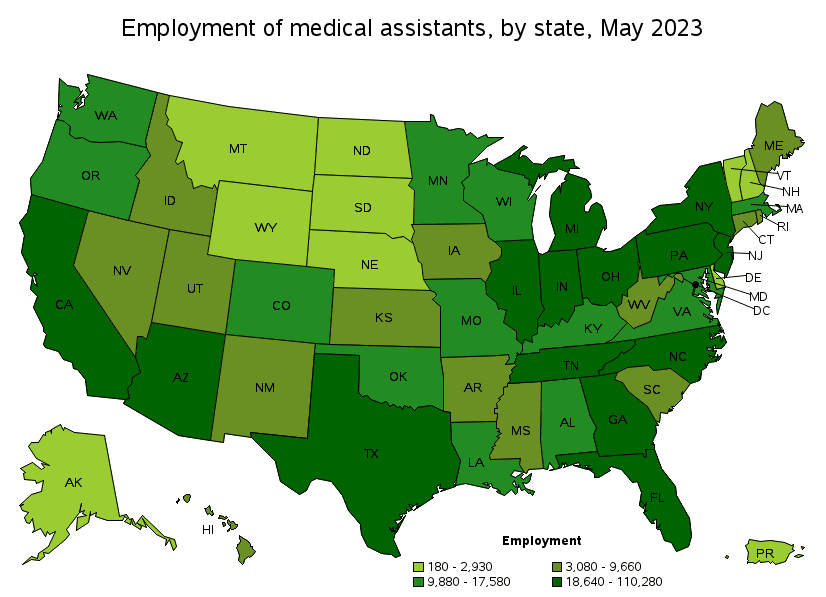
Source: www.bls.gov
If you are considering relocating, remember to factor in the cost of living, licensing requirements, and proximity to medical training institutions.
The highest-paying regions for medical assistants
If your primary focus is on income potential, it’s helpful to know where medical assistants make the most money. The U.S. Bureau of Labor Statistics (BLS) has published data on medical assistant salaries by state in 2025, identifying top-paying states with robust healthcare systems and high outpatient service demands.
Many of these states also set competitive wage scales due to union presence, expanded responsibilities, or state-led compensation initiatives. They often include relocation support and sign-on bonuses, especially in regions facing staffing gaps. Below, we have a list that clearly says where medical assistants make the most money.
According to the BLS, the highest-paying states for medical assistants in 2025 include:
- Washington: $53,780
- Alaska: $52,530
- California: $50,900
- Massachusetts: $44,570
- Minnesota: $50,110
While these states offer the highest salaries, they also come with strong benefits packages, advancement opportunities, and competitive job environments. However, job seekers should carefully evaluate the cost of living to assess the true value of compensation.
For those seeking both financial stability and abundant opportunities, these may be the best states for medical assistant jobs in terms of pay and growth.
Medical assistant job market trends in 2025
The medical assistant job market is expected to grow significantly in 2025. The BLS projects a 14% growth rate in medical assistant roles—far above the average for all occupations. This surge is fueled by healthcare system expansions, aging populations, increased access to insurance, and a shift toward value-based care.
Beyond hospitals, medical assistants are now finding opportunities in outpatient centers, urgent care clinics, and even telehealth and remote-care support roles. These alternative care models are reshaping how and where medical assistants are employed.
Several states—particularly Texas, Florida, and Arizona—are leading this growth due to strong healthcare investment and rising populations. Monitoring medical assistant job demand by state helps you identify promising regions with stable employment prospects. These trends spotlight the best states for medical assistant jobs for long-term career advancement. To align your job search with these trends, partnering with a reliable allied health staffing agency can help you connect with openings in high-demand states faster and more efficiently.
How to get a medical assistant job: transition & entry guide
Whether you are a recent graduate or considering a shift from another profession, transitioning into medical assisting is a structured and achievable process. If you are just starting, your first step is to enroll in an accredited medical assistant program. This will equip you with essential clinical and administrative skills, such as patient care, billing, medical coding, and basic medical procedures.
Most employers prefer certified candidates. Taking the CMA (Certified Medical Assistant) exam significantly improves your job prospects. Additionally, many programs include externships, which allow you to gain real-world experience while still studying.
If you are already working in a different field and wish to pivot, begin by evaluating your current skills, gaining certifications, and building clinical experience through hands-on training.
Here is a simple guide to finding medical assistant jobs:
- Enroll in an accredited medical assistant program
- Obtain a certification such as CMA
- Complete internships or externships
- Customize your resume to highlight skills like multitasking, patient interaction, and clinical exposure
These steps outline exactly how to get a medical assistant job, even in a competitive market. Whether you are a recent graduate or making a transition, this career is highly accessible with the right preparation. In addition to gaining certifications, it is equally important to prepare for interviews confidently. To help you succeed, we have covered the top 20 medical assistant interview questions and answers in detail.
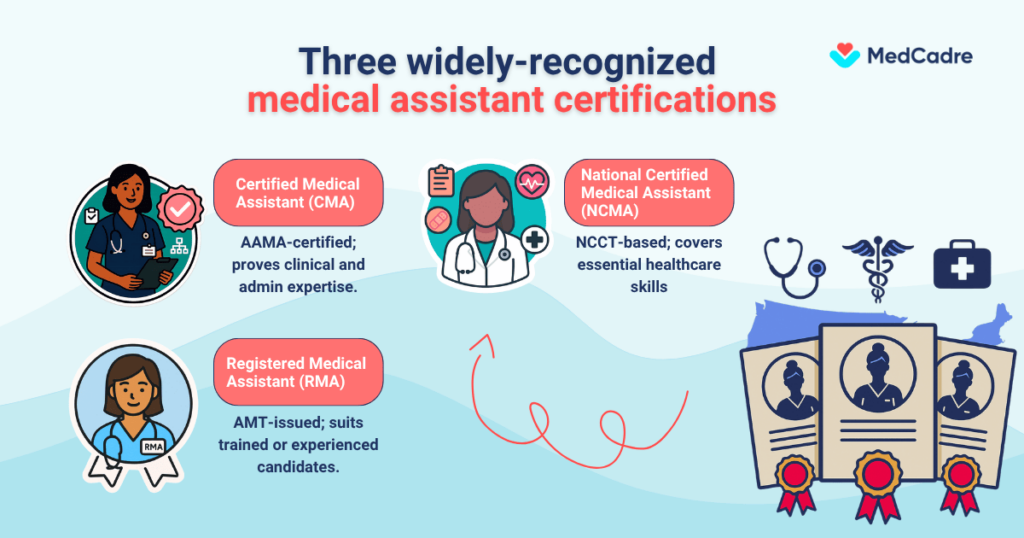
Also, remember that there are multiple types of medical assistant certifications, and the three most widely recognized ones in the USA are as follows:
Choosing the right allied health staffing partner
Navigating the job market as a medical assistant can be exciting, but also overwhelming, especially when relying on traditional staffing agencies. Many of these agencies still operate with outdated systems, offer unclear compensation breakdowns, and can delay your job placement through long credentialing processes and limited job transparency.
For individual medical assistants seeking to make informed, career-forward choices, it’s crucial to find a staffing partner that prioritizes speed, fairness, and accuracy at every step.
That is where MedCadre comes in. Our AI-powered portal accelerates the credentialing process by 30%, ensuring you can begin your assignment on schedule. Our transparent pricing model ensures that most of the bill rate is directly paid to you, providing medical assistants with a clear and fair understanding of their earnings. Our integrated timesheet system guarantees prompt approvals, so you get paid on time and without errors.
Looking for your next opportunity? Search current openings, and you can also submit your resume and get matched with jobs that align with your skills and goals.
Instead of navigating outdated processes or unclear agency markups, choose a modern solution designed for today’s healthcare professionals. MedCadre helps you land jobs faster, with more control and clarity—whether you are just starting or advancing in your medical assisting career.
FAQs
What qualifications are required to become a medical assistant?
You typically need to complete an accredited medical assistant program and obtain certification, like CMA or RMA. Some roles may accept entry-level candidates, but certification significantly improves job prospects.
How long does it take to become a certified medical assistant?
Programs typically take 9–12 months to complete, with certification exams taken shortly after. Some programs offer externships for additional real-world experience.
Are internships or externships required for medical assistant jobs?
They are not always required, but are highly recommended. Internships give you hands-on experience and often help you secure your first job faster.
How fast can I get placed in a job through MedCadre?
Our platform speeds up credentialing by up to 30%, helping you get placed quickly and on schedule. This reduces your wait time and boosts job access.
Can I apply to MedCadre if I am a recent graduate?
Yes, we welcome new grads with or without certification. Our platform also connects you to roles that match your current credentials and experience level.