Physical therapy offers multiple specialty paths that help professionals boost their income and maintain job stability while delivering better patient care. This blog explores the best physical therapist jobs and provides details on the top specialties in the USA. It shows how each specialty supports career development in physical therapy. The specialty areas let you develop specialized knowledge that aligns with patients’ evolving needs. The programs provide certifications to help physical therapists maintain their competitive edge when they move into specialized clinical roles through strong physical therapist jobs.
Why choose a speciality in Physical Therapy?
By selecting a specialty, you can position yourself to advance your career into a higher-level role (or a higher salary or to become a clinical supervisor/manager) while continuing to work on the types of patients you want to work with every day.
Furthermore, these specializations align with many current trends in healthcare, including care for seniors, post-operative rehabilitation, sports injury rehabilitation, and rehabilitation following neurological injury.
They provide a clear pathway to obtaining a physical therapy certificate or to pursuing additional education beyond PT certification. When selecting a specialty, you can better align your current skills with areas of increasing demand in physical therapy.
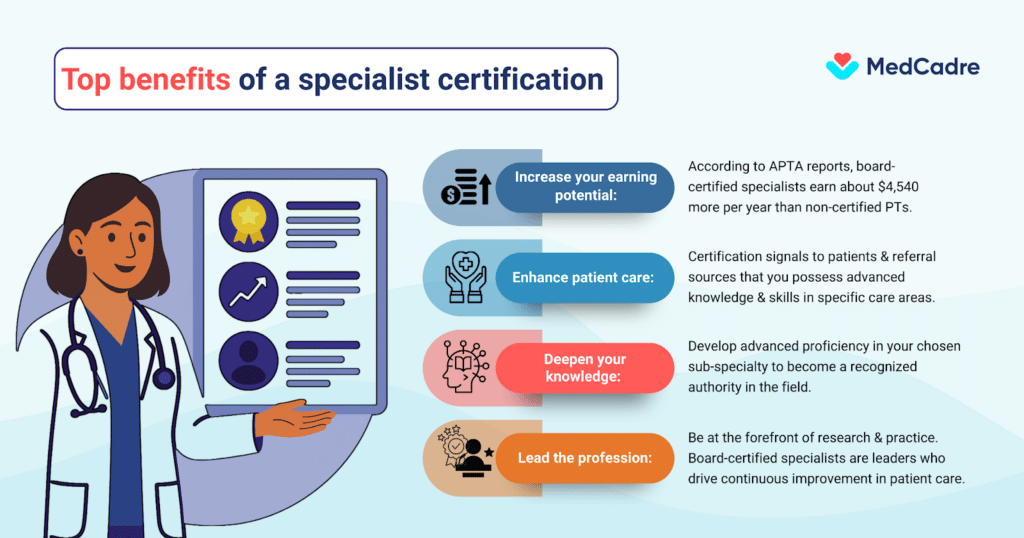
This will help you in creating a greater variety of job opportunities for physical therapists. There are several benefits to choosing a specialty, and the key points have been highlighted in the infographic for easier understanding.
Most sought-after physical therapy specializations
1. Orthopedic physical therapists
Orthopedic physical therapists provide assessment and treatment for patients with injuries to bones, joints, ligaments, muscles, connective tissue, or nerves, as well as for patients recovering from surgery. Orthopedic physical therapists most often practice in facilities that provide outpatient services, such as outpatient clinics, sports rehabilitation facilities, or rehabilitation hospitals.
Their primary focus is helping patients return to work, sports, or daily activities through a combination of exercise and manual therapy, as indicated by their philosophy of practice and/or by the use of proven techniques in physical therapy.
1) Certification: Orthopaedic Clinical Specialist (OCS) from the American Board of Physical Therapy Specialties (ABPTS)
2) Duration: Typically 2,000 hours of direct orthopedic patient care or completion of an accredited residency before the exam
3) Fees: $535–$635 application + $810 exam (APTA members)
2. Geriatric physical therapy
To help older adults deal with the many conditions associated with the aging process (e.g., arthritis, osteoporosis, decreased ability to balance, reduced ability to walk), Geriatric PT helps them remain as independent as possible, providing them with the tools to reduce their chances of falling and helping them manage chronic diseases.
Through Geriatric Physical Therapy, many of these individuals can continue to live independently, thereby making Geriatrics an area of growth for many physical therapist jobs.
1) Certification: Geriatric Clinical Specialist (GCS) from the American Board of Physical Therapy Specialties (ABPTS)
2) Duration: Typically 2,000 hours of geriatric patient care or completion of an accredited residency before the exam
3) Fees: $535–$635 application + $810 exam (APTA members
3. Pediatric physical therapy
Pediatric PT is a form of treatment that helps infants, young children, and teenagers. Children with delays in their development, congenital problems (or conditions present at birth), neurological issues, and injuries are all handled by Pediatric physical therapists.
In many cases, Pediatric therapists work in schools, hospitals, and pediatric clinics, where they will develop play-based treatment programs that help children continue to grow and develop as they move through the developmental process. The need for Pediatric PT will continue to grow across many physical therapy careers.
1) Certification: Pediatric Clinical Specialist (PCS) from the American Board of Physical Therapy Specialties (ABPTS)
2) Duration: Typically 2,000 hours of pediatric patient care or completion of an accredited residency before the exam
3) Fees: $535–$635 application + $810 exam (APTA members
4. Neurologic physical therapy
Physical therapy for neurological disorders targets rehabilitation for individuals who have suffered a stroke, sustained a spinal cord injury, been diagnosed with multiple sclerosis or Parkinson’s Disease, or have experienced some other type of neurological disorder.
The therapist uses a variety of techniques to assist the individual with relearning to move, improving their balance, and adapting to their impairments. These specialists play an essential role in multifaceted rehabilitative therapies and often help pave the way toward becoming a physical therapist through a physical therapist certification.
1) Certification: Neurologic Clinical Specialist (NCS) from the American Board of Physical Therapy Specialties (ABPTS)
2) Duration: Typically 2,000 hours of neurologic patient care or completion of an accredited residency before the exam
3) Fees: $535–$635 application + $810 exam (APTA members)
5. Sports physical therapy
Physical therapy for sports emphasizes injury prevention, performance enhancement, and rehabilitation of athletes and other physically active individuals of any age. The specialty of sports physical therapy is often attractive to people who are interested in sports therapy and performance. It may be found in sports medicine clinics, professional or school teams, and high-performance training facilities.
1) Certification: Sports Clinical Specialist (SCS) from the American Board of Physical Therapy Specialties (ABPTS)
2) Duration: Typically 2,000 hours of sports patient care or completion of an accredited residency before the exam
3) Fees: $535–$635 application + $810 exam (APTA members)
Career opportunities and outlook
The overall outlook for PTs is strong, and therefore, PTs with additional specialties will have an advantage when pursuing advanced positions (e.g., lead therapist, clinic director, program manager). These specialties will provide PTs with a variety of options, including opportunities in hospitals, private practice, rehabilitation centers, sports medicine facilities, and home care agencies throughout their careers in physical therapy.
Additionally, obtaining Board Certification supports continued career advancement by enhancing the ability to transition into teaching, consulting, or leadership roles while maintaining proficiency in clinical expertise.
Obtaining the appropriate physical therapist certification will help you broaden your reach, enabling you to build a foundation for higher-paying PT positions.
Understanding salary and compensation ranges across different roles is essential for physical therapists, as this insight helps them target opportunities that align with their financial goals. To support that effort, a detailed infographic that breaks down physical therapist salary structures by state across the nation.
Annual wage of physical therapists by state

Why MedCadre is the right partner after your PT certifications
You must complete the necessary certifications to enter physical therapist jobs and similar career paths. The credentials enable you to work in various states and environments, making you a more qualified and dependable candidate. But certifications alone do not guarantee the right fit. Your physical therapy career needs appropriate staffing support to help you reach better positions and long-term achievement.
While many candidates begin their job searches on free job boards, results tend to vary widely from one person to the next. Others use traditional staffing agencies, which can result in a lengthy hiring process, ineffective communication, and a cumbersome overall experience.
All of these issues can hinder your ability to land high-quality positions and, therefore, slow your progress in your physical therapy career. To reach your career goals, a planned approach is to use a modern healthcare staffing platform such as MedCadre.
Instead of dealing with long waits, hidden fees, or confusing processes, MedCadre, a healthcare staffing platform, helps you find the healthcare role that matches your skills. This can give your physical therapy career a real boost. The platform is designed to make job searching more straightforward and more efficient. This healthcare staffing platform has many benefits, such as:
Key benefits include:
- A flexible application process that lets you manage your job search at your own pace.
- We offer transparent pricing so you receive a fair share of the billing rate
- Quick credentialing that speeds up processing by nearly 30%, ensuring faster job starts.
- An AI-integrated timesheet for quick approvals, accurate records, and on-time payments.
With these benefits, MedCadre becomes a reliable partner for your healthcare job search. Be a regular visitor to the current openings page to find and apply for these jobs that fit your requirements, and you can also submit your resume with basic details if you cannot find a job that relates to your requirements or skills. This platform is designed to support your growth in physical therapist jobs.
FAQs
Do I need extra certifications to grow in physical therapy?
Not always, but advanced certifications can help you qualify for specialized roles and better pay. They also make your profile stronger in healthcare careers. For instance, a Certified Orthopedic Manual Therapist (COMT) certification can boost your earning potential in outpatient clinics.
Are certifications required for every healthcare role?
Not always, but many employers prefer candidates who demonstrate commitment through specialized training. This is especially true for roles such as ICU nursing or radiology techs, where certifications like ACLS or ARRT may be mandatory for compliance and patient safety.
Do specialized certifications really increase salary?
Yes. Certified professionals often earn more because employers value advanced training and proven skills. Data from the U.S. Bureau of Labor Statistics shows certified physical therapists earn up to 15% more annually than non-certified peers in similar roles.
Why should I choose MedCadre over traditional job boards?
Unlike standard job sites, MedCadre provides personalized matching, transparent pay information, and faster onboarding, helping you secure better opportunities with less effort.
Can I apply for multiple jobs at the same time?
Absolutely. MedCadre allows you to apply to as many positions as you want, making it easier to compare opportunities and choose the best fit. Our dashboard tracks all your applications in real-time so that you can prioritize responses without missing deadlines.