
Phlebotomist jobs are ideal for anyone who enjoys hands-on clinical work and direct patient interaction. They also provide strong entry-level pathways into broader healthcare careers. When choosing a healthcare role that aligns with your goals, consider your lifestyle, strengths, and the direction you want your future to take.
Professionals exploring entry-level clinical roles that allow them to build skills must understand how a facility operates and prepare for long-term career growth. If you prefer routine, structure, and laboratory procedures, you may find that medical lab technician positions align more closely with your interests.
This blog clarifies the differences between lab-focused and patient-facing roles so you can make a practical, informed decision. If you are interested in phlebotomy, it also highlights how a phlebotomist’s role compares to the day-to-day workflow in a lab environment. For individuals who enjoy analytical work or behind-the-scenes tasks, transitioning into a medical lab technician role can offer a strong, rewarding career path.
Salary overview of the phlebotomy career
As a phlebotomist, you are often one of the first people to interact with patients, especially in hospitals, blood donation centers, and outpatient clinics.
Healthcare facilities continue to seek reliable clinical support, which is why demand for phlebotomy jobs has grown in recent years. As a phlebotomist, you complete a short certificate program, allowing you to begin working sooner than many peers in other healthcare roles. This makes phlebotomy jobs accessible for individuals who want to enter the field quickly.
Entry-level roles typically offer steady salaries and job growth, reflecting stability for those beginning their careers. With experience, phlebotomists can move into positions in fast-paced hospitals, outpatient centers, and specialty clinics, all of which offer opportunities to increase earnings. Remember that phlebotomy salaries often vary by location, certification, and experience.
For individuals seeking a career with room to grow, phlebotomy offers steady advancement without requiring years of schooling. This makes it a strong option for people interested in patient care but seeking a quicker path into the workforce.
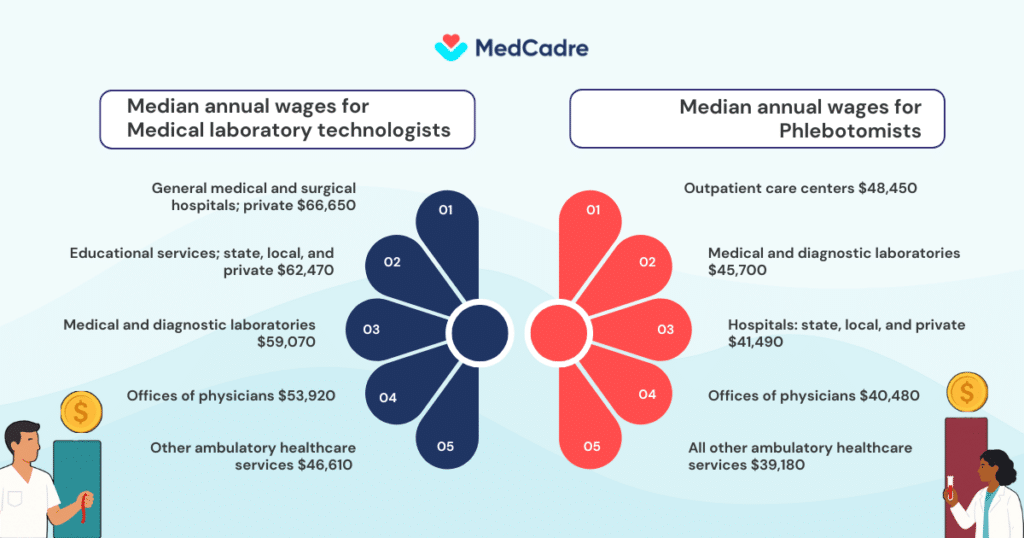
If you are considering a career change or exploring opportunities as a phlebotomist or medical lab technician, it is important to stay aware of current compensation trends. Understanding this information can help you secure a better job. A detailed infographic is provided for clearer insight.
Medical lab technician job overview
If you are interested in a job where you spend most of your time performing laboratory tests, analyzing samples, and providing diagnostic information to physicians, a career as a medical lab technician (MLT) may be a strong fit for you. These professionals handle patient samples, operate complex laboratory instruments, and follow strict procedures to ensure quality assurance.
To qualify for most MLT positions, you need an associate’s degree and completion of a clinical practicum. This training provides a solid foundation for laboratory-based careers. MLTs work in hospitals, private laboratories, and research facilities, giving you the flexibility to choose the environment that best suits your interests.
Many individuals enter the medical laboratory technician (MLT) job because they understand the importance of diagnostic testing and the role MLTs play in delivering accurate results. Choosing medical lab technician jobs can offer career stability and growth opportunities.
Healthcare facilities are actively seeking skilled laboratory technicians who can perform tests accurately and consistently. This growing demand has attracted more students and individuals seeking a career change, particularly those who enjoy detail-oriented, analytical work. The medical lab technician’s salary is also a motivating factor for many candidates.
Differences in the day-to-day job environment
Phlebotomists and medical laboratory technicians (MLTs) work in very different settings. Experienced phlebotomists spend most of their day with patients. They draw blood from adults, elderly individuals, and sometimes children. Their work requires moving between rooms and maintaining constant contact with patients. Good communication skills are important because they help keep patients calm.
MLTs work mostly behind the scenes. They stay in the lab and focus on testing samples. Their tasks include using instruments, checking for technical issues, and recording accurate results. Unlike phlebotomists, MLTs usually work in a quiet and structured environment.
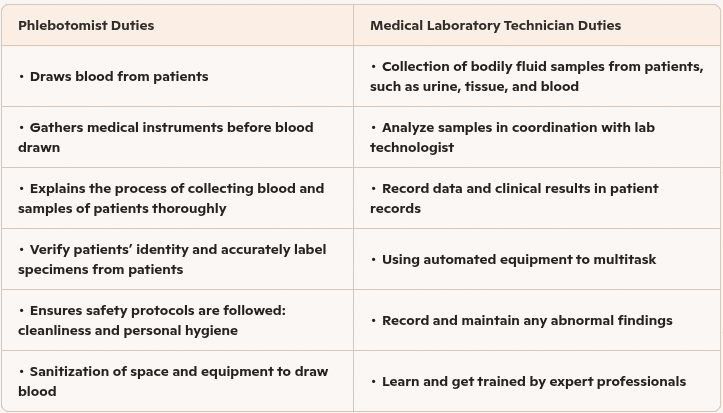
Your comfort level can help you choose the right path. If you enjoy talking to patients and staying active, phlebotomy may be a good fit. If you prefer detailed, technical work, the medical laboratory technician role might suit you better. To help you compare the two careers, a detailed infographic is provided for a clearer understanding.
Comparison of phlebotomist and medical laboratory technician duties
Source: www.trainingdirectusa.com
Career growth and lifestyle factors
Both phlebotomy and medical laboratory technician (MLT) roles offer meaningful opportunities for advancement. With experience in phlebotomy, you may transition into leadership roles, mobile phlebotomy services, or broader clinical pathways. For MLTs, career growth often includes becoming a medical technologist, specializing in areas such as microbiology or hematology, or progressing into laboratory supervisory positions.
Lifestyle preferences also play a key role in determining which career aligns best with your goals. Phlebotomy often offers flexible scheduling, especially for morning draws, outpatient clinics, and inpatient support. In contrast, MLTs typically work more structured shifts tied to testing demands, allowing for predictable hours and a steady routine.
Gaining hands-on analytical experience in a laboratory setting through medical lab technician roles is especially beneficial for individuals seeking long-term job stability and growth opportunities within the science field. When choosing between a career centered around patient interaction or scientific analysis, consider the skills you want to build and the work environment that feels most comfortable for you.
Selecting the right candidate during the hiring process helps ensure that a laboratory or clinic operates efficiently and that patients receive consistent, high-quality care.
Secure your ideal phlebotomy or medical lab technician job faster
As someone seeking phlebotomy jobs or medical lab technician jobs with the right skills and certifications, partnering with a healthcare staffing platform can significantly improve your chances of landing the role you want. Many job seekers rely on free job sites or personal referrals. While convenient, these options often lead to slow hiring timelines, leaving candidates waiting weeks or even months for a suitable opportunity. Others turn to traditional staffing agencies, which may involve challenges such as high fees, slow communication, and limited transparency around pay and assignments.
To avoid these setbacks, job seekers can benefit from using modern healthcare staffing platforms like MedCadre. A platform built for speed and efficiency, MedCadre helps simplify every step of your job search.
Key advantages of MedCadre include:
- A streamlined application process that helps you manage your job search without disrupting your current responsibilities.
- An AI-powered portal that accelerates credentialing by 30%, helping you start your new assignment on time.
- MedCadre’s integrated timesheet system ensures accurate and timely payments.
- Transparent pricing model that guarantees fair allocation of your earnings.
By leveraging MedCadre, you can increase your chances of landing your desired phlebotomy jobs or medical lab technician jobs quickly and efficiently. Check our current openings page, and you can even submit your resume with just your basic details to kickstart your journey toward your ideal healthcare role.
FAQs
What is the difference between a phlebotomist and a medical laboratory technician?
Phlebotomists focus on patient interaction and blood collection, while medical lab technicians focus on analyzing samples and performing lab tests. Both roles are essential in healthcare.
What qualifications do I need to apply for medical lab technician jobs?
Most MLT jobs require an associate’s degree and completion of a clinical practicum. Experience as a laboratory technician can also improve job prospects.
What career advancement opportunities exist for medical lab technicians?
With experience, healthcare professionals can lead to supervisory roles or to specialization in areas such as hematology and microbiology. A strong foundation as a laboratory technician is essential for growth.
What makes MedCadre better than traditional staffing agencies for medical lab technician jobs?
Unlike traditional agencies, MedCadre reduces delays, minimizes administrative hurdles, and provides a transparent process. Job seekers can start assignments faster and receive timely payments with this AI-powered platform.
Does MedCadre offer transparency in phlebotomy technician salaries?
Absolutely. MedCadre’s pricing model guarantees that a significant portion of the bill rate goes directly to you, making the phlebotomy technician’s salary clear and fair. This ensures you know your earning potential from the start.