In today’s competitive healthcare job market, a strong resume for healthcare jobs while avoiding resume red flags is the first step to securing a successful career opportunity! However, many qualified job seekers miss out on opportunities or fail to convey their qualifications accurately in their CVs. From weak formatting to vague language choice, even minor errors can send the wrong message to hiring managers.
This blog will highlight some common resume blunders in healthcare that can damage your CV and provide insights on how to best present yourself with professionalism and care. Whether you are applying for a nursing job or a pharmacist role, it is equally important to know what to exclude and what to highlight. Your objective in your resume should be to provide the facts of your accomplishments, as well as demonstrate your professionalism and ability to succeed in a healthcare environment.
#1. Adding unclear or generic career objectives
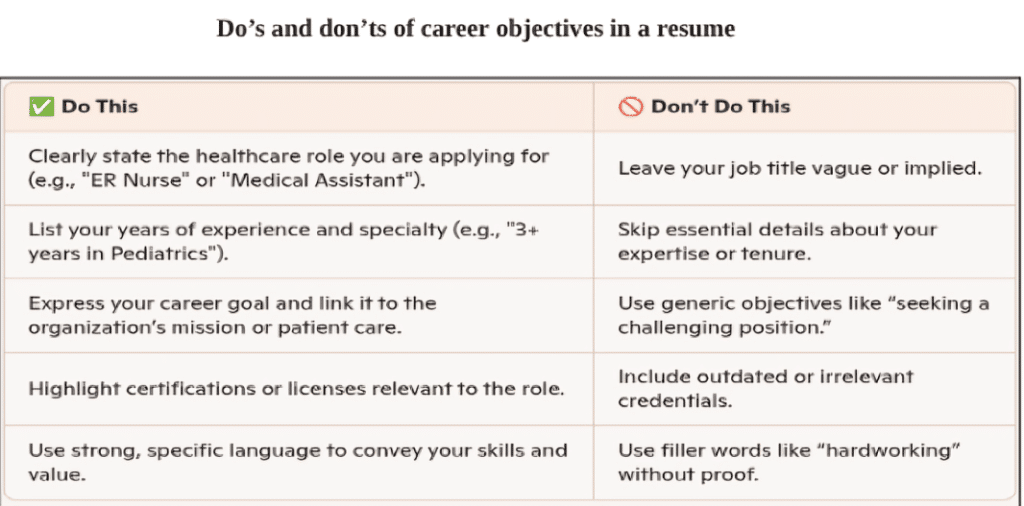
The lack of specificity in your career objective can cause your resume for healthcare jobs to feel unclear. Healthcare recruiters want to be confident that you have a clear understanding of your career goals and how they align with the specific role. A career objective of “contributing to a healthcare setting” is simply not enough. It is important to be specific both about the direction of your professional path and what value you will bring.
Instead of vague descriptors like motivated or generic terms such as reliable that could apply to any job, clearly state the exact healthcare position you are targeting, your years of experience, and your area of specialty. For example, “ER Nurse with 3+ years in Pediatrics” instantly tells the recruiter who you are and what you offer. This clarity at the top of your resume sets the trajectory for the rest of your application and signals a strong sense of purpose, a crucial step in creating a perfect resume for healthcare and avoiding resume red flags.
#2. Overused or unprofessional formatting
Unprofessional or inconsistent formatting sends a message stating that attention to detail is lacking within you. In healthcare, where precision is critical and mistakes are dealbreakers, you should never turn in any document that is not perfect. Do not use overly creative fonts, inconsistent alignment, or long, dense blocks of text.
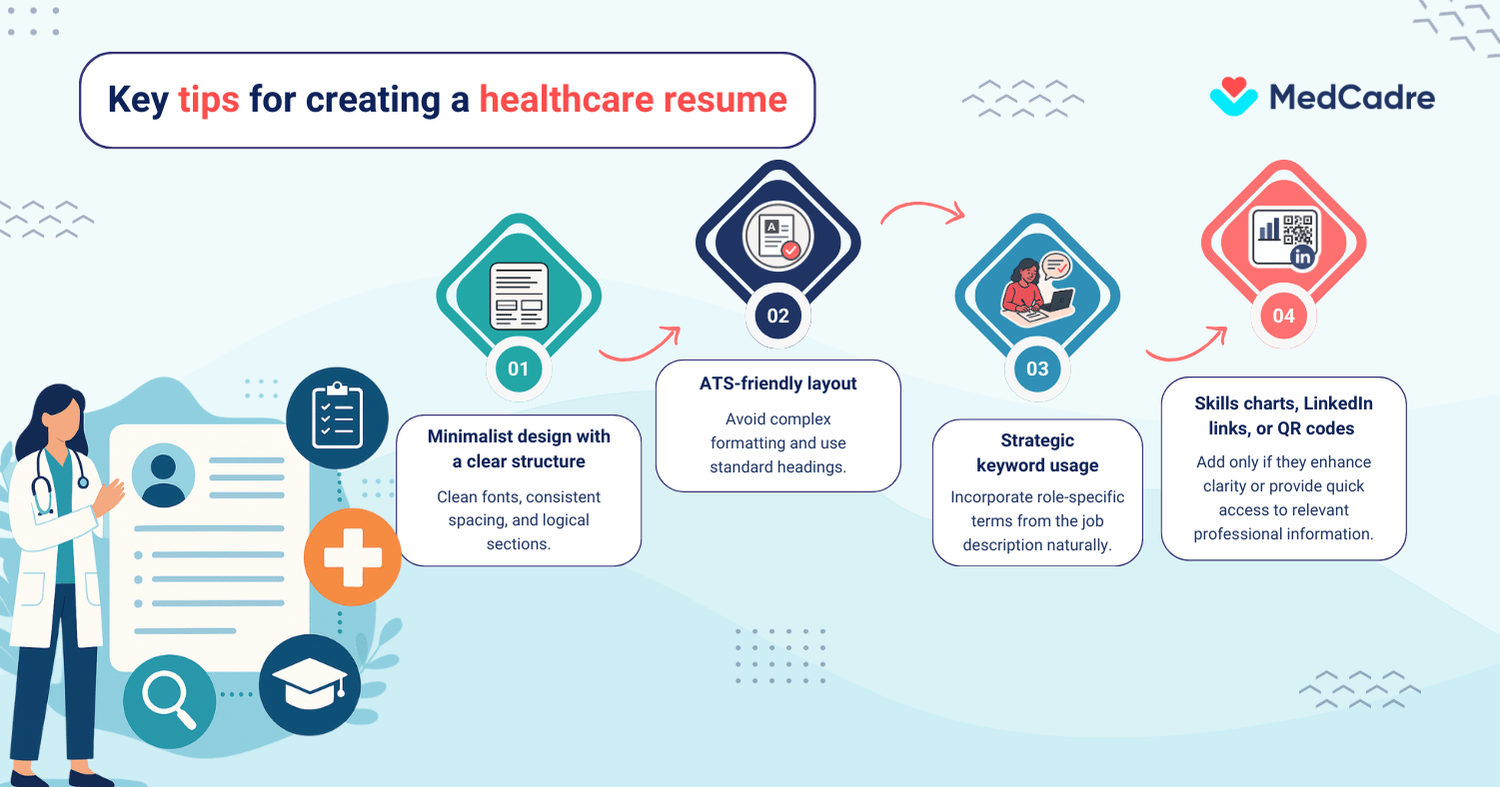
Professional formatting will help your qualifications pop while allowing for easy readability. A well-organized format indicates that you appreciate organization, which is important in both clinical and administrative roles. These healthcare resume tips can help you be noticed by hiring teams:
- Use clean, professional fonts, such as Arial or Calibri, no smaller than size 10–12.
- Use consistent spacing, bolding, and section headers to help lead hiring teams through your resume.
- Save and send the resume as a PDF, unless another type of file is requested.
#3. Including irrelevant work experience
When you include unrelated jobs, you may unintentionally take the focus off your qualifications for the healthcare role. Since career changes, along with location changes, are common, they often highlight their previous roles that are not in healthcare; it is helpful to remember your transferable skills.
Ultimately, an employer wants to see specific achievements that relate to their role and exemplify your readiness for that position. Failing to do this is a common mistake on healthcare resumes and a CV red flag.
- Prioritize jobs where you provided patient care, clinical support, or worked in healthcare operations and administration.
- Prioritize listing your healthcare certifications, licenses, or training you received that were specific to healthcare and your role.
- Use bullet points and action words to describe your achievements and responsibilities.
Also read: Transitioning to a new state? Relocation tips for medical providers
#4. Using technical language without clarity
Using field-specific terminology will show your reader that you understand the industry; however, not every hiring manager or recruiter who assesses your resume will necessarily understand all your terminology. If you use too much technical language or do not explain your experience in an accessible way, you may find your resume removed from consideration.
Avoid appearing robotic or overly conceptual while using abbreviations without explanation. With the construction of a professional document, clarity is paramount. The purpose should be to demonstrate skills associated with professional credibility without using unnecessary jargon or complex text. It is crucial that you avoid resume red flags and common resume blunders in healthcare.
- Define lesser-known medical terminology or abbreviations, the first used.
- Write in a way that HR personnel and clinical staff will understand.
- Show how your technical knowledge improved care or outcomes.
#5. Omitting key metrics and achievements
A common red flag is describing your position without demonstrating impact. Numbers and measurable outcomes help authenticate your efforts. This is applicable for all healthcare roles, not just careers with direct patient exposure in bedside nursing or back-office support.
Employers want results-driven candidates. With numbers, you offer direct evidence of your performance and work ethic. All of this is important if you are looking to build a perfect resume for healthcare and avoid resume red flags.
- Quantify patient loads or improvement rates where possible.
- List education, certifications, or credentials like BLS, ACLS, or HLC
- Highlight leadership contributions, efficiency improvements, or formal recognition by peers or supervisors.
Why experienced healthcare professionals should choose smarter staffing solutions
As an experienced working professional seeking a job change, the first and fundamental step is to have a well-written CV for healthcare jobs. Once your resume is ready, the next step is to search for suitable jobs that match your skills, goals, and values. While searching for opportunities, many individuals often partner with traditional staffing agencies, either out of habit or due to limited awareness of alternatives. Unfortunately, this route may come with several drawbacks. Traditional agencies can lack transparency, offer slower credentialing, and often do not guarantee timely payments.
That is where MedCadre offers a smarter solution. MedCadre is a bright option for professionals looking to make a meaningful career move:
- MedCadre’s flexible application process allows you to manage your job search seamlessly without disrupting your current responsibilities.
- Its transparent pricing model ensures that most of the bill rate goes directly to your pay, making it ideal for those looking to advance in their careers.
- The AI-powered portal accelerates credentialing by 30%, allowing you to begin your assignment on time.
- MedCadre’s integrated timesheet system ensures prompt approvals and on-time payments with no errors.
You can submit your CV directly through the MedCadre portal and regularly check the current openings for roles that match your specialty. If you are seeking a smarter platform that values your time, ensures clarity in compensation, and streamlines your hiring journey, MedCadre is the right choice for your next step in healthcare.
FAQs
What is the most important thing to include in a healthcare resume?
The most important aspect is to highlight relevant healthcare experience, certifications, and achievements. Always include measurable outcomes and specific skills related to patient care, administrative duties, or technical roles, depending on your expertise. Following a resume checklist for healthcare jobs can help ensure nothing important is missed.
How long should a resume for healthcare jobs be?
Ideally, a healthcare resume should be one to two pages. Focus on clarity, relevance, and structure. Avoid cramming too much unrelated information, and prioritize experience that aligns with the job you’re applying for.
How can I make my healthcare resume stand out to recruiters?
Use a clean, professional layout and emphasize outcomes, not just responsibilities. Incorporate relevant keywords like resume red flags and use bullet points to highlight key achievements.
How does MedCadre make the job search process easier for healthcare professionals?
MedCadre offers a flexible application process that lets you manage your job hunt without affecting your current role. Its AI-powered portal accelerates credentialing, getting you ready for work faster.
What makes MedCadre better than traditional staffing agencies?
Unlike traditional agencies that may delay payments and slow down credentialing, MedCadre ensures timely payments and expedited onboarding through integrated systems.